


For The Birds: Helping Birds Travel Safely During Fall Migration


The annual fall migration sends millions of birds through the Fort Wayne area as they navigate to winter homes in the southern United States, Central America and even South America.
It’s a long, difficult and dangerous trek. There are things we can do, though, to boost the odds they will have a safe and successful journey.
Northeast Indiana lies within the Mississippi Flyway, the airborne path bird species in the Midwest and central Canada use on their way south. October marks the peak of migration traffic.
“Shorebirds migrate earliest, around the end of July, leaving their babies way up north to find their own way later,” said Cynthia Powers of Fort Wayne, an avid birder. Cynthia and her husband, Ed, are longtime members of the Three Rivers Birding, the local chapter of the National Audubon Society. They also are longtime supporters of Little River Wetlands Project.
“They (shorebirds) like the mud flats at Eagle Marsh,” Cynthia noted. “Next come the songbirds through the woods, and last the ducks. Eagle Marsh has had many Great Egrets this summer, which will be leaving soon for the Gulf coast.”
She also expects hummingbirds to depart about the first week of October.
“It's fun to look at the range maps in a field guide, such as the Sibley Eastern guide (‘The Sibley Field Guide to Birds of Eastern North America’); it tells the summer, winter, and migration routes for each species,” Cynthia added.
About 80% of North American bird species migrate at night, the U.S. Fish and Wildlife Service reported on its website, https://www.fws.gov/story/threats-birds-collisions-nighttime-lighting.
The number of birds passing this way can total in the millions on busy nights. The Cornell Lab of Ornithology BirdCast Migration Dashboard, for example, estimated nearly 2.5 million birds flew over Allen County on a recent September night. The dashboard estimated more than 17 million birds passed through Indiana on the same night.
HOW YOU CAN HELP
You can take specific actions to assist birds during their fall migration. Here are a few ideas:
• Preserve natural areas where they can land, rest and find food.
“Of course, protecting habitat is most important, and LRWP is doing just that,” Cynthia said.
Her husband, Ed, has kept a list of bird species seen at Eagle Marsh since it was established in 2005. The list now includes 260 different bird species, she said.
At home, putting out bird feeders and a water source in your yard can be a welcome treat for avian travelers who happen to drop in for a rest stop.
• Reduce your lawn area and fill the newly open space with native plants.
Migrating birds need places where they can rest safely and find nectar, seeds, berries and insects to refuel their bodies. Native plants offer all of those benefits, the Cornell Lab of Ornithology said on its web page, “Seven Simple Actions to Help Birds,” https://www.birds.cornell.edu/home/seven-simple-actions-to-help-birds/.
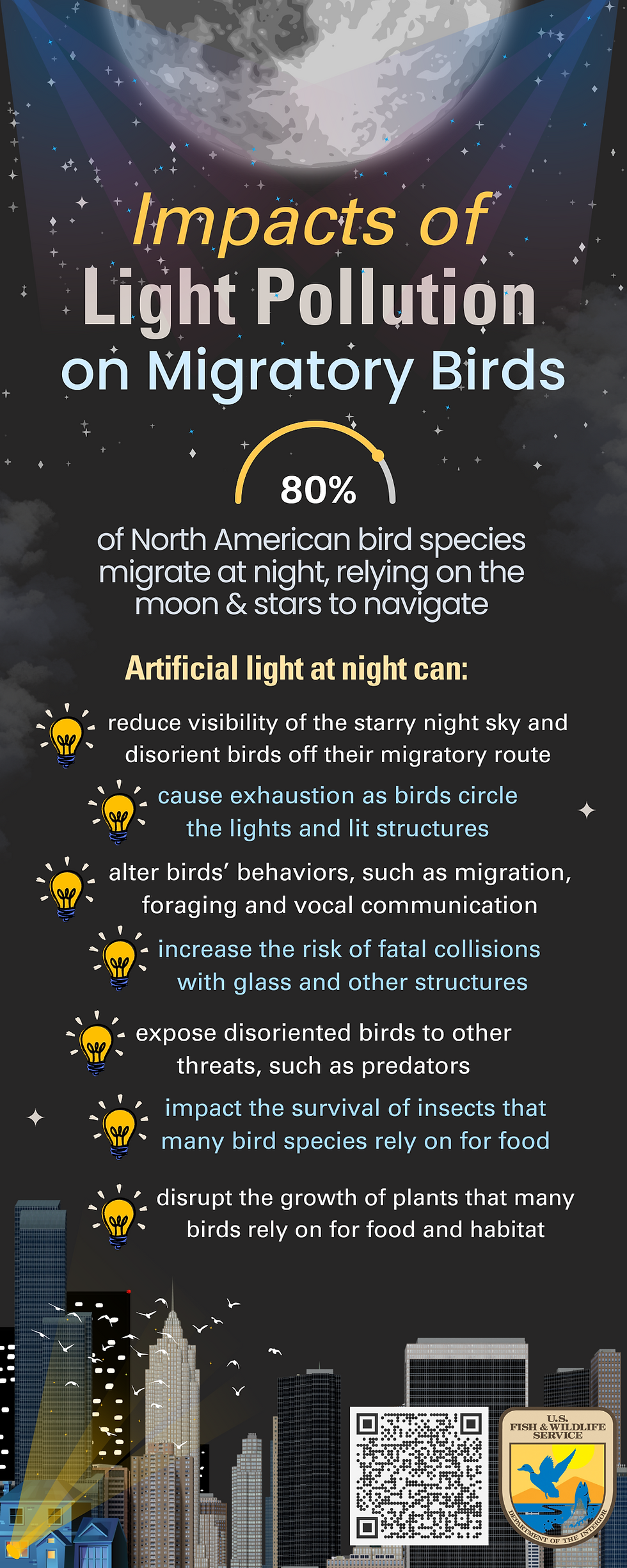
affect migrating birds. (By Rosalie Wetzel of U.S. Fish and Wildlife Service)
• Turn off outdoor lights at night.
“Birds do navigate by the stars and the Earth’s magnetic field, and have crashed into buildings at night,” Cynthia said. “A few years back, a lot of them crashed into McCormick Place in Chicago, leaving much carnage to be seen the next day.”
Lighting can attract migrating birds from as far as 3 miles away, the U.S. Fish and Wildlife Service said.
“Once drawn in, birds often circle the illuminated area, wasting critical energy needed for migration and increasing their risk of collisions with buildings and other structures,” the Fish and Wildlife Service explained. “This phenomenon is particularly prevalent on nights with low cloud ceilings or foggy weather, when birds tend to migrate at lower altitudes where light reflecting on clouds may greatly disorient and attract birds to illuminated areas.”
Cynthia Powers has read that the Gateway Arch in St. Louis turns off its lights during fall migration. Birders in Indianapolis have promoted a “Lights Out Indy” campaign to encourage downtown buildings to turn off outdoor lights during the fall migration, she added.
The Cornell Lab of Ornithology recommends turning off outdoor lights from 11 p.m. to 6 a.m. daily during migration, which usually tapers off by the end of October.
If you need to use outdoor lighting, use amber, orange, red or warmer-colored LED lighting because birds are less likely to respond to it, the Fish and Wildlife Service said. Blue, white or cooler light colors cause more problems for birds. Also, keep lights dim and pointed at the ground rather than upward, the Fish and Wildlife service recommended.
• Make glass windows visible.
Birding organizations recommend sticking dots or strips on the outside of windows to ensure birds see the glass and don’t try to fly through the window.
The Cornell Lab of Ornithology recommends placing the objects 2 inches apart all across the window glass.
The National Audubon Society suggests turning it into a fun kids art project. Children’s decal creations then can be attached to windows so birds see the glass or don’t get fooled by a window reflecting nearby vegetation or the sky. Project details are at https://www.audubon.org/news/make-migration-friendly-window-decorations.
• Keep cats indoors.
Cats instinctively hunt and kill birds, taking a combined estimate of 2.4 billion birds yearly in the U.S. and Canada, the Cornell Lab said in its “Seven Simple Actions to Help Birds” web article.
Yes, cats will protest. But don’t they always complain about something? And it’s only for a few weeks. Maybe they can get in some extra naps and fur grooming.
• Avoid using pesticides.
Pesticides used around a house or business can be toxic to birds, the Cornell Lab article said. Birds can be exposed to pesticides if they come in contact with the chemicals or eat prey or seeds that have been treated with pesticides, the article noted.
• If you drink coffee, be sure it’s shade-grown.
Drinking sun-grown coffee encourages growers to cut down native habitat to plant more coffee fields, the Cornell Lab article said. That destroys natural areas many birds need to survive the winter.
• Watch for birds and report sightings.
Scientists “need hundreds of thousands of people to report what they’re seeing in backyards, neighborhoods and wild places around the world,” the Cornell Lab article said. “Without this information, scientists will not have enough timely data to show where and when bird species are declining around the world.”
You can report bird sightings by participating in programs such as eBird, Project FeederWatch, Christmas Bird Count and Breeding Bird Survey, the Cornell Lab article said.
With your help, more of your feathered friends will reach their winter destinations and have a chance to visit you again this spring.
MIGRATION TRAFFIC COUNTERS
To view the Cornell Lab of Ornithology BirdCast Migration Dashboards for Allen County and Indiana, check out these links:
Allen County: https://dashboard.birdcast.org/region/US-IN-003


Comments