


Give a gift to science this holiday season: Take part in the annual Christmas Bird Count


Volunteers go out on a day between Dec. 14 and Jan. 5 to count and identify all of the bird species they see and hear. The count has been taking place annually since 1900.
“The data collected by the CBC (Christmas Bird Count) participants over the
past century have become one of only two large pools of information informing ornithologists and conservation biologists how the birds of America are faring over time,” the National Audubon Society said on its website, www.audubon.org.
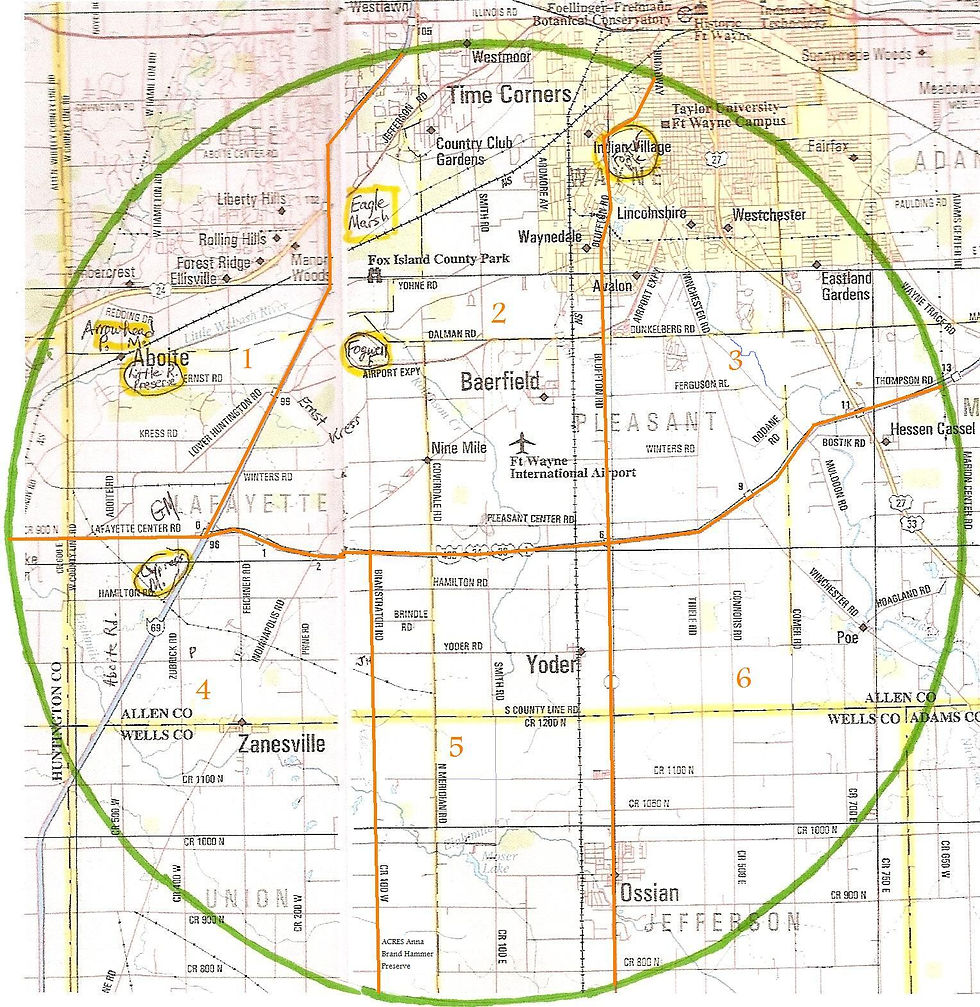
To prevent people from overlapping and duplicate counting, Christmas Bird Count survey areas are divided into 15-mile diameter circles. The Southwest Allen County survey circle includes residential neighborhoods, farm land and natural areas, such as Little River Wetland Project’s Eagle Marsh and Arrowhead Preserves, Fox Island County Park, and ACRES Land Trust’s Fogwell Forest nature preserve.
The Southwest Allen County count will take place Saturday, Dec. 27, Cynthia Powers, the Southwest Allen County count compiler, said by email. Count compilers organize the bird counting in their survey circle, compile data collected by volunteers and send it to the National Audubon Society’s Christmas Bird Count database.
Powers, who also is a Little River Wetlands Project volunteer, said the Southwest Allen County survey area still has room for people who want to join count teams or to count birds at their home bird feeders if the residents live in the survey area. You need to contact her at zzedpowers@aol.com soon to sign up so people won’t be counting the same area twice.
“Beginners are welcome, and I’d assign them to a team with more experienced birders,” Powers said.
She divided the survey circle into six territories. Survey teams meet up and cover their assigned territory, which can include hiking through areas or driving along country roads, she said. They identify the bird species they see and count them. If they encounter large flocks of birds, the team provides an estimated number.
“Last year, we saw 56 species, which tied our record,” said Powers, who established the Southwest Allen County survey circle in 2015.
Home feeder watchers will collect the same information, but without leaving their houses.
The count period goes for 24 hours, so participants can count any owls or other birds they see or hear at night, Powers said.
You also don’t have to spend the whole day out looking for birds.
“I tell people the CBC (Christmas Bird Count) is half for fun and half for science,” Powers said.
One of the fun highlights on counting day, she noted, is the chili lunch the Southwest Allen County survey group holds at the Fox Island County Park Nature Center.
“We list the species seen so far on the overhead projector, and after lunch people can go finish their territories or go home to watch their feeders,” she said.
Bird sightings can include surprises, Powers noted. Count volunteers discovered a snowy owl one year along Homestead Road.
After the count day, participants report their bird count results to Powers, who compiles the information and sends it to the National Audubon Society. More details about the Christmas Bird Count are available at https://www.audubon.org/community-science/christmas-bird-count.
So if a day outside doing a good deed for science sounds like fun, contact Powers and count yourself in on this year’s Christmas Bird Count.
Another Option
If you can’t participate in the Christmas Bird Count, you can help birds and science by participating in the Great Backyard Bird Count on President’s Day weekend each February. In 2026, the count window will be Feb. 13-16, the National Audubon Society website said.
To participate, count and identify all of the birds you see or hear in your yard, the website said. You can count for as little as 15 minutes or as long as you want, and on as many days as you want during the four-day count window. You then submit your results.
Audubon suggests using the Merlin Bird ID mobile device application or the eBird Mobile application to record and identify the birds you see or hear. The apps automatically file your bird sightings with the Great Backyard Bird Count. If you want to enter the bird count data manually, set up an account through the Cornell University Lab of Ornithology. For a link and other participation details, go to https://www.birdcount.org/participate.


Comments